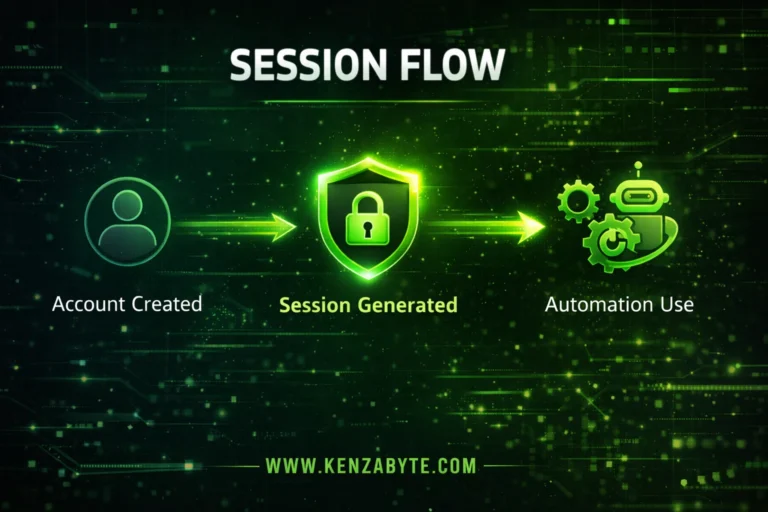

Why Telegram Accounts Get Banned: IP Behavior and Proxy Isolation Explained
This article explains how platforms like Telegram track activity using IP addresses, why repeated actions from the same IP lead to failures, and how proxy isolation improves stability. The goal is to break down system behavior in a simple way, show real failure patterns, and explain why structure matters when actions scale, which is defined at a system level in how to build a Telegram account creator system.
How Telegram Tracks IP Activity?
Every request sent to a platform includes an IP address, which acts as the observable source of activity.
Platforms such as Telegram, WhatsApp, and Instagram analyze how each IP behaves over time rather than treating it as static data.
They evaluate:
- Frequency of requests
- Type of repeated actions
- Timing consistency between actions
Natural, irregular behavior blends in. Structured and repeatable behavior becomes distinguishable.
At low volume, this distinction is weak. At scale, it becomes a primary factor in system response
How Platforms Actually See Your Activity?
Platforms evaluate activity through combined identity signals rather than individual accounts.
An identity consists of:
- IP address
- Device-level characteristics
- Behavioral patterns over time
Even when device characteristics vary, shared network origin can still link activity.
Simple Example
Imagine creating 10 accounts.
Case 1: Same IP
- All 10 requests come from one IP
- Same steps repeated
- Similar timing between actions
Result: appears as one source repeating actions
Case 2: Different IPs
- Each request uses a different IP
- No overlap in source
Result: appears as separate users
The process is identical. Only the network identity changes.
This difference is what platforms use to decide whether activity is normal or not.
How Do Platforms Detect Repeated Activity Patterns?
Platforms look for patterns, not isolated events.
They monitor:
- Number of actions from a single IP
- Speed and frequency of those actions
- Similarity between repeated steps
- Time gaps between actions
A single action does not trigger anything.
A repeated structure creates a recognizable pattern.
Example:
If one IP continuously performs:
Register → wait → verify → repeat
And this sequence repeats with similar timing, the system starts building confidence that the activity is not random.
Over time:
- Trust in that IP decreases
- Additional checks may be applied
- Some actions begin to fail
This is not immediate. It builds gradually as the pattern becomes clearer.
Why Do Telegram Actions Start Failing Over Time?
Failures are often misunderstood as random issues. In reality, they follow consistent causes.
1. Activity Aggregation
When multiple actions use the same IP, they are grouped together.
This creates:
- A single visible source
- Stronger patterns
- Higher detection probability
Example: If 50 accounts are created from one IP:
- The system does not see 50 independent users
- It sees one source repeating the same behavior
This makes detection easier and faster.
2. Repetition Over Time
Even small volumes can fail if repeated in the same way.
Example:
- 5 accounts created every hour
- Same steps each time
- Similar delays
This creates a stable pattern.
Platforms are more sensitive to consistency than to raw volume.
3. IP History and Reputation
Not all IPs behave equally.
Clean IP
- Minimal previous activity
- No strong negative patterns
- Higher acceptance
Used or flagged IP
- History of repeated or structured actions
- Lower acceptance
Example: Two identical processes:
- One runs on a fresh IP → works normally
- One runs on a heavily used IP → fails early
The difference is not the process. It is the IP’s past behavior.
What Happens When Telegram Starts Limiting Activity?
On Telegram, these patterns show up as:
- OTP messages not arriving
- Delays during verification
- Account creation is failing without clear errors
- Gradual drop in success rate
These are system responses, not random bugs.
Other platforms show similar behavior:
- Additional verification steps
- Temporary restrictions
- Slower processing
The pattern is consistent across systems.
Why Is My Number Banned from Telegram?
A common assumption is that the phone number is the issue.
In most cases, the problem is the activity linked to that number through the network.
Restrictions happen when the system detects:
- Too many actions from the same IP
- Repeated account creation attempts
- Similar workflows executed multiple times
- Short and predictable time gaps
Even different numbers can be linked through one shared IP.
Example
- 5 different phone numbers
- All used from the same IP
- Same registration steps
Result: The system sees one repeating source, not independent users.
This leads to:
- OTP failures
- Numbers being restricted
- Verification issues
Key Point:
The restriction is not directly tied to the number.
It is tied to the pattern connected to that number.
Changing numbers without changing structure produces the same outcome.
What Is Proxy Isolation and Why Does It Matter?
Proxy isolation separates activity at the network level.
Basic structure:
- One process uses one IP
- No IP sharing
- Each process acts independently
Example: Without Isolation
- 20 processes use 1 IP
- System sees one identity
- High pattern visibility
Example: With Isolation
- 20 processes use 20 IPs
- System sees independent identities
- Low pattern visibility
Same actions, different outcome.
Why Does Proxy Isolation Reduce Detection?
Isolation changes how activity appears to the system.
Instead of a single observable source, activity is distributed across independent origins.
This reduces:
- Pattern strength
- Correlation between actions
- Detection signals
On Telegram, this improves:
- OTP delivery consistency
- Registration success rate
Does Proxy Isolation Work with Low-Quality IPs?
If IPs are already flagged, isolation alone is not enough.
Example:
- 10 processes
- 10 low-quality or previously flagged IPs
Result: Failures continue
Isolation requires acceptable IP quality to be effective.
What Is the Difference Between Isolation and Rotation?
These two concepts serve different roles.
Isolation
- Separates identities
- Prevents grouping of actions
Rotation
- Changes IP over time
- Prevents long-term pattern buildup
Too much rotation creates instability. No rotation allows patterns to accumulate.
Balanced use improves consistency.
How Does IP Structure Affect System Stability?
Without isolation:
- Activity is concentrated
- Patterns become clear
- Detection increases over time
With isolation:
- Activity is distributed
- Patterns weaken
- Stability improves
This directly affects long-term reliability.
Conclusion
Failures on Telegram are driven by the concentration of activity within a single network origin and consistent execution patterns over time.
Stability improves when identity is distributed, and behavioral overlap is reduced.

Arabella Montrose
I have over 8 years of experience in content writing, specializing in Telegram automation, user-friendly tools, and social media marketing services. I work closely with the Kenza Byte team to ensure every article I write is accurate, clear, and genuinely helpful for users and businesses focused on digital growth.