
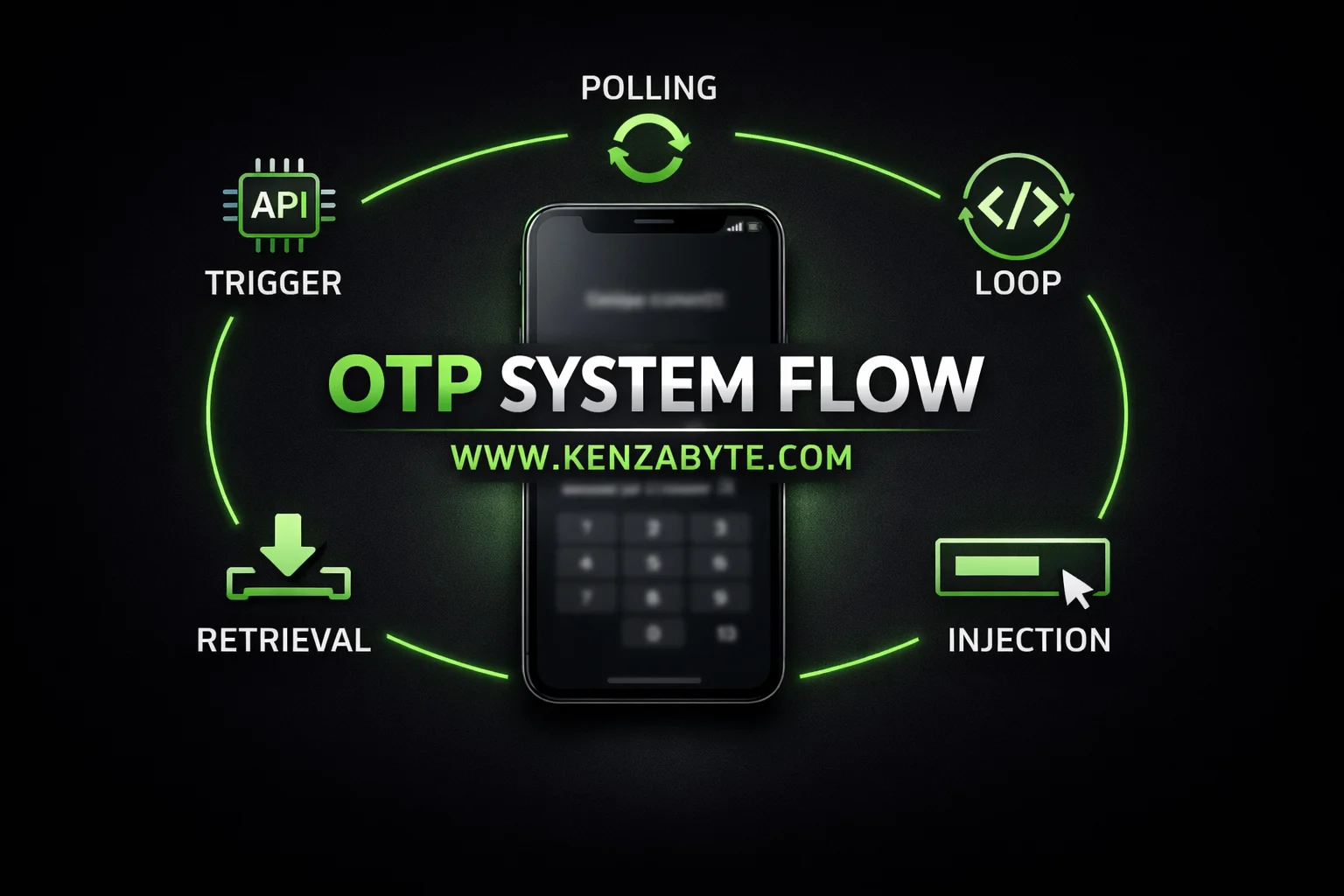
How Automated OTP Handling Systems Flow Work
Learn how automated systems handle OTP verification through request triggering, API polling, detection loops, code retrieval, and injection.
How Does an Automated OTP Handling System Operate?
OTP handling in automated environments follows a fixed execution sequence. The system progresses through defined states where each stage performs a specific operation and produces a structured output. This sequence operates as a sub-process within the account creation basic flow.
This output is passed forward without modification outside the defined process. No stage operates independently, and no stage overlaps with another within a single cycle.
The process is continuous and repeatable. Each cycle begins from an initial trigger state and proceeds through a controlled flow until it reaches a terminal state. If the process does not complete successfully, the system resets and begins a new cycle with a fresh input. All behavior is governed by predefined conditions and state transitions.
OTP handling functions within a Telegram verification workflow, where number sourcing, request triggering, and session activation are structured as dependent stages in a continuous execution process.
What Initiates an OTP Request in the System?
The execution begins when the system initiates a verification request.
Actions:
- Submit phone number to Telegram
- Send a request for OTP generation
System state:
- Request is registered as active
- Internal state is initialized for tracking
- The monitoring process is activated
Input: Phone number
Output: Active OTP request state
At this stage, the system creates a linkage between the phone number and the current execution instance. No further action occurs until the process moves into the next state.
How Does the System Poll for OTP Data?
After the trigger stage, the system enters a polling state to monitor OTP availability.
Polling mechanism:
- Send repeated requests to the number provider API
- Receive structured responses for each request
Polling behavior:
- Executes at fixed time intervals
- Maintains consistent request format across iterations
- Continues until a defined exit condition is reached
Input: Active request state
Output: Response payload (OTP or empty)
Each polling request produces a response payload. The system does not store intermediate results unless required for evaluation. The polling state remains active without interruption until the detection loop transitions to an exit condition.
How Does the Detection Loop Evaluate OTP Responses?
Polling operates within a continuous loop that evaluates responses.
Loop sequence:
- Send request for OTP status
- Receive response payload
- Evaluate response content
- Repeat sequence
Evaluation conditions:
- Check if the response contains OTP data
- Check if the response indicates no data
- Check if limits are reached
Exit conditions:
- OTP detected in response
- Maximum polling attempts reached
- Timeout condition reached
Input: Response payload
Output: OTP detected flag or loop continuation
Transition:
- OTP detected → move to OTP retrieval
- Maximum attempts or timeout → move to fallback
The loop maintains a consistent structure across all iterations. No variation is introduced during execution. Each iteration follows the same request and evaluation pattern until an exit condition is satisfied.
How Is the OTP Retrieved from the Response?
When the detection loop identifies OTP data, the system transitions to retrieval.
Actions:
- Access response payload containing OTP
- Parse structured data fields
- Extract OTP value from payload
- Store extracted value in process memory
Input: Response payload containing OTP
Output: Extracted OTP value
Transition: Extracted OTP → move to injection process
The retrieval stage isolates only the required data element. No additional information from the payload is processed beyond what is necessary for the next stage. The extracted OTP is prepared in a format compatible with the verification input stage.
How Is the OTP Injected into the Verification Flow?
After retrieval, the system transfers the OTP to the verification interface.
Actions:
- Send OTP value to the active execution instance
- Populate the verification field with extracted code
- Submit a verification request to Telegram
Input: Extracted OTP value
Output: Submitted verification request
Transition: Submitted OTP → move to verification stage
The injection stage directly follows retrieval. The system does not introduce intermediate steps between extraction and submission. The OTP value is used as received from the retrieval stage without transformation outside formatting requirements.
What Happens After OTP Submission?
Following submission, the system evaluates the response from the verification endpoint.
Possible states:
- Verification accepted
- Verification rejected
- No response or invalid response
Input: Submitted OTP
Output: Verification status (accepted/rejected / no response)
Transition:
- Verification accepted → cycle complete
- Verification rejected or no response → move to fallback
The result of this stage determines whether the process completes successfully or transitions into fallback. No additional retries occur within this stage unless defined in a separate execution cycle.
What Happens If OTP Verification Fails?
If verification does not complete successfully, the system enters a fallback state.
Conditions:
- OTP not detected within loop limits
- OTP present, but verification rejected
- Response not received within the allowed duration
System response:
- Terminate current execution instance
- Release or discard the associated phone number
- Clear temporary process data
- Reset the system state to the initial condition
- Initiate a new cycle with new input
Input: Failed verification state
Output: Reset system state
Fallback is a terminal state for the current cycle. The system does not resume a failed cycle. Instead, it starts a new execution sequence from the beginning.
How Are States Connected in the OTP Process?
Each stage in the process is connected through direct state transitions.
Characteristics:
- Output from one stage becomes input for the next
- No parallel execution within a single cycle
- No stage skipping or reordering
- Each state is completed before the next begins
The system maintains strict continuity across all stages. Execution remains linear and deterministic, ensuring that each cycle follows the same structural path.
What Defines the Behavior of the OTP Handling System?
An automated OTP handling system operates with the following properties:
- Sequential execution across defined stages
- Continuous polling within a loop structure
- Fixed evaluation and exit conditions
- Direct data transfer between stages
- State reset upon fallback
- Identical execution structure across cycles
Each property defines how the system progresses from initiation to termination without variation in flow.
Conclusion
Automated OTP handling follows a fixed execution sequence:
trigger → polling → detection loop → retrieval → injection → verification → fallback
Each stage represents a controlled state within the system. The process advances only when conditions for transition are met. If the sequence does not complete successfully, the system resets and begins a new cycle with a fresh input.

Arabella Montrose
I have over 8 years of experience in content writing, specializing in Telegram automation, user-friendly tools, and social media marketing services. I work closely with the Kenza Byte team to ensure every article I write is accurate, clear, and genuinely helpful for users and businesses focused on digital growth.