Batch vs Continuous Account Creation: Which Model Is Safer?
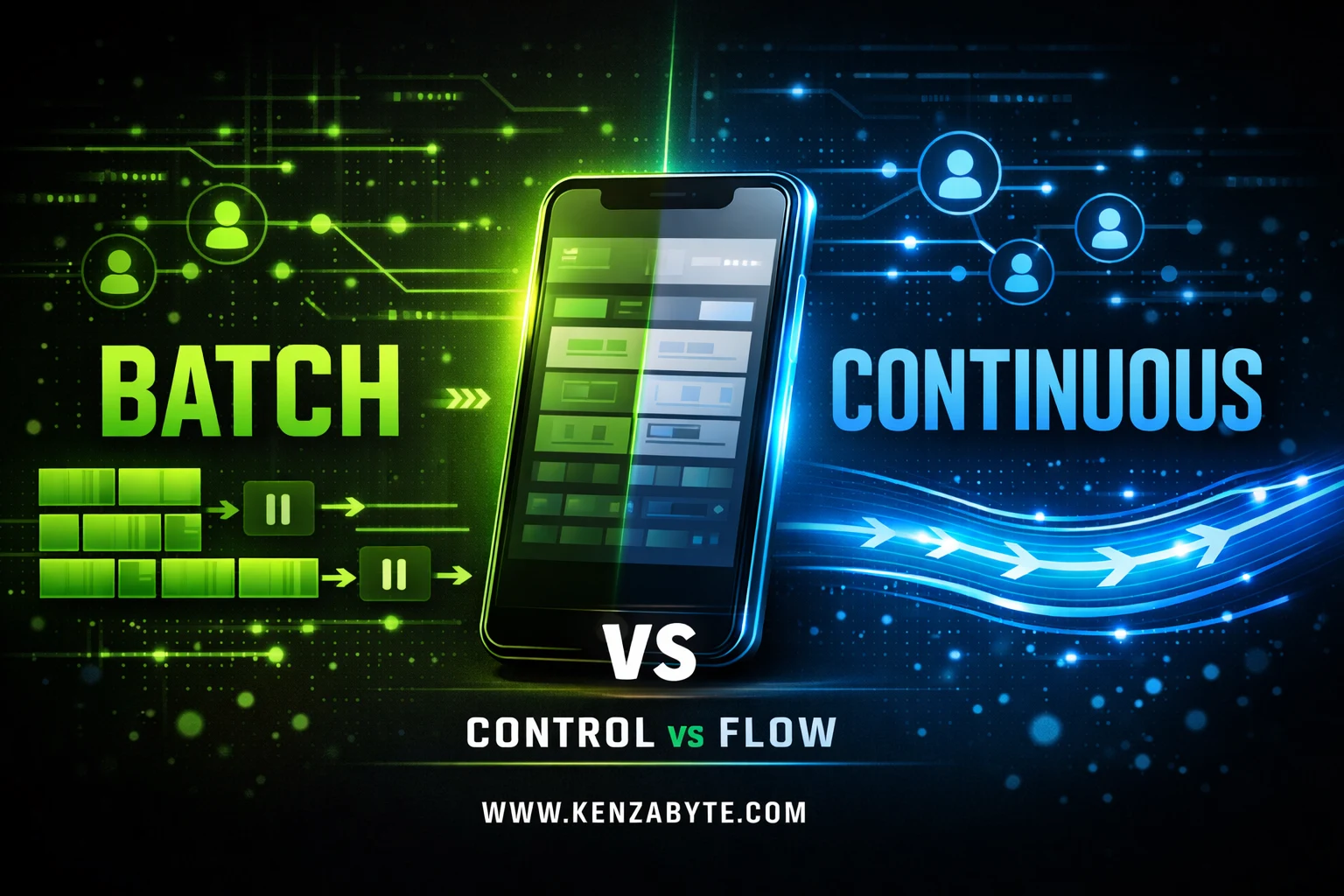
Batch and continuous execution models define how automated systems are structured over time. This article analyzes how segmentation affects failure containment, observability, resource recovery, and control without overlapping concurrency design concepts.
What Does Execution Segmentation Change in System Behavior?
Execution segmentation defines how work is grouped and processed over time. It determines whether a system operates in isolated cycles or as a continuous stream.
This is independent of how many tasks run at once.It focuses only on temporal structure: whether execution is divided or uninterrupted.
Two models define this behavior:
- Batch execution (segmented)
- Continuous execution (uninterrupted)
This distinction directly affects system stability, failure boundaries, and operational control.
This execution model is one part of a larger system structure. See the complete Telegram account creation system guide to understand how it connects with other layers.
Execution Segmentation vs Continuous Flow
Batch systems operate by dividing work into clearly defined units. Each unit completes before the next begins, creating separation between execution phases.
Continuous systems remove this separation. Work flows without interruption, and task completion immediately triggers the next operation.
This difference introduces two distinct system states:
- Segmented execution with defined boundaries
- Continuous execution with no boundaries
These states determine how systems react under stress, not how fast they run.
Execution structure defines whether tasks are grouped or continuous, but it does not determine how many tasks run at once. For a comparison of task concurrency and its effect on throughput and scaling, refer to Sequential vs Parallel Account Creation.
How Does the Batch Execution Model Structure System Activity?
Batch execution organizes work into controlled cycles. Each cycle is treated as a complete and isolated unit of execution.
Structure
- Defined workload per cycle
- Explicit start and termination
- An idle or evaluation gap before the next cycle
System Behavior
Each batch creates a closed execution window. Once it ends, the system pauses before continuing. This pause is not incidental—it is part of the design.
System state becomes stable between cycles. No tasks are active during this interval, allowing accurate observation.
Effect
- Activity is contained within known limits
- System state is stable at defined points
- Execution phases are clearly separated
Batch execution introduces order through enforced boundaries.
What Changes When Execution Becomes Continuous?
Continuous execution removes the concept of cycles entirely. The system does not stop between workloads.
Structure
- Tasks are processed without interruption
- No defined start or end point
- No separation between execution phases
System Behavior
The system remains in a constant active state. There is no moment where execution fully pauses.
State transitions occur while tasks are still running. This creates overlapping execution states that cannot be easily separated.
Effect
- Activity is uninterrupted
- System state is always in transition
- Boundaries between operations disappear
Continuous execution prioritizes persistence over structure.
How Do Failure Boundaries Differ Between Segmented and Continuous Systems?
Failure handling is determined by whether execution boundaries exist.
Batch Model
Failures are restricted to the active batch. Once the cycle ends, the system stops before proceeding further.
This creates a hard boundary:
- Errors do not extend beyond the batch
- Faults are evaluated before continuation
- System integrity is preserved between cycles
Continuous Model
Failures occur within an ongoing stream. There is no natural stopping point to isolate them.
This results in:
- errors affecting subsequent operations
- accumulation of faults over time
- gradual degradation instead of isolated failure
Result
Segmentation enforces failure boundaries. Continuous flow removes them.
Why Does Observability Depend on Execution Boundaries?
System visibility depends on whether outputs can be tied to specific execution windows.
Batch Execution
Each cycle produces a self-contained result. Inputs and outputs exist within the same boundary.
This allows:
- direct correlation between cause and outcome
- precise identification of failure sources
- clean separation of execution states
Continuous Execution
Outputs are generated across overlapping activities. There is no clear separation between one state and another.
This leads to:
- mixed results from different execution phases
- unclear mapping between input and output
- difficulty isolating root causes
Result
Segmented systems produce clear observations. Continuous systems produce blended observations.
What Role Do Recovery Windows Play in System Stability?
Recovery behavior is embedded in how execution is structured.
Batch Model
Between cycles, the system enters a non-active state. This creates a recovery window where:
- resource usage drops
- temporary strain is released
- system conditions normalize
This recovery is automatic. It does not require additional control logic.
Continuous Model
No such window exists. The system remains active at all times.
This results in:
- sustained resource consumption
- no natural reset point
- gradual buildup of pressure
Result
Batch execution includes recovery phases by design. Continuous execution removes them entirely.
Why Does Continuous Execution Increase Behavioral Consistency?
Execution patterns become more uniform when no interruption exists.
Continuous Systems
Operations occur at consistent intervals due to uninterrupted flow:
- stable execution timing
-
Repeated activity cycles
- predictable behavioral patterns
This consistency makes system behavior easier to model but also easier to recognize.
Batch Systems
Execution is broken by gaps between cycles:
- timing varies between batches
- activity is not uniform
-
patterns are less consistent
Result
Continuous systems produce stable patterns. Batch systems introduce variability.
How Does Control Differ Between Segmented and Continuous Execution?
Control depends on when system changes can be applied.
Batch Model
Changes are introduced between cycles. The system is inactive, and its state is stable.
This allows:
- isolated adjustments
- clear measurement of impact
- no interference from ongoing tasks
Continuous Model
Changes occur during active execution. The system does not pause.
This creates:
- overlapping configurations
- difficulty measuring outcomes
- interference between system states
Result
Segmented execution enables controlled modification. Continuous execution requires adjustment during instability.
How Do These Models Fit Without Overlapping Concurrency Design?
Execution segmentation operates independently from how tasks are processed.
- Segmentation model → defines when execution occurs
- Concurrency model → defines how tasks run
This separation ensures no overlap with thread, process, or instance design.
Segmentation defines system timing and does not control task distribution or parallelism.
Execution segmentation remains separate from system architecture. Concepts such as threading, processing, and instance-based scaling define how workloads are executed within the system. These are explained in Multi-Threading and Multi-Instance Systems in Automation
When Is Segmented Execution Structurally More Suitable?
Batch execution aligns with systems that require controlled behavior.
Applicable conditions:
- environments requiring clear state separation
- systems under testing or calibration
- operations where failure isolation is critical
Segmented execution is used where control and predictability are prioritized over continuity.
When Does Continuous Execution Become Necessary?
Continuous execution aligns with systems requiring uninterrupted operation.
Applicable conditions:
- pipelines where stopping introduces disruption
- mature systems with stable configurations
- environments optimized for sustained throughput
Continuous execution is viable only when monitoring and correction mechanisms are already reliable.
What Constraints Are Introduced by Each Execution Structure?
Each model introduces structural limitations.
Batch Constraints
- inactive periods between cycles
-
delayed response to new workloads
- lower immediate output rate
Continuous Constraints
- absence of failure boundaries
- no built-in recovery phase
- increased dependency on external control systems
These constraints are inherent to the structure, not implementation choices.
Conclusion
Execution segmentation defines system safety through structural control.
Batch execution enforces boundaries. It limits failure spread, provides recovery intervals, and maintains clear system visibility.
Continuous execution removes these boundaries. It sustains activity but increases exposure to failure, reduces traceability, and eliminates natural recovery.
System safety is determined by containment, not continuity. Batch execution provides containment through segmentation. Continuous execution requires external mechanisms to achieve the same stability.

Arabella Montrose
I have over 8 years of experience in content writing, specializing in Telegram automation, user-friendly tools, and social media marketing services. I work closely with the Kenza Byte team to ensure every article I write is accurate, clear, and genuinely helpful for users and businesses focused on digital growth.