How Email Validation Works: Step-by-Step Guide for Marketers
In this blog, you’ll learn how email validation works, why it is important, and how it can help your emails reach the right audience. Email validation ensures that the addresses you send emails to are real and safe. This helps you reduce bounce rates, protect your sender reputation, and improve email marketing results.
What Is Email Validation?
Email validation is the process of checking whether an email address is real, correctly formatted, and capable of receiving messages. It ensures that the emails you send actually reach real inboxes rather than bouncing back or being flagged as spam.
Think of email validation as a “health check” for your email list. Instead of blindly sending messages, you check first if the address exists and is active.
Difference Between Email Validation and Email Verification
Many marketers confuse email validation with email verification, but they serve different purposes. Understanding the difference is crucial for maintaining a healthy email list and ensuring your campaigns succeed.
Email Validation: Email validation is primarily concerned with technical deliverability. It answers the question: “Can this email receive messages?”
Email Verification: Email verification focuses on identity and authenticity. It answers the question: “Does this email belong to a real person?”
Key Differences in Simple Terms
| Feature | Email Validation | Email Verification |
|---|---|---|
| Focus | Deliverability | Identity |
| Purpose | Can the email receive messages? | Does the email belong to a real person? |
| Checks | Syntax, domain, MX records, disposable emails | Account ownership, activity, and fraud detection |
| Goal | Reduce bounces, protect sender reputation | Ensure emails reach genuine users |
| Use Case | Marketing campaigns, email hygiene | User registration, fraud prevention, and CRM accuracy |
Why Email Validation Matters
Validating emails is not just a technical step—it has real benefits for your business and marketing success. Here are the key benefits of email validation:
1. Reduces Bounced Emails
A bounced email occurs when a message cannot be delivered. Too many bounced emails can make email servers flag your account as spam. For example, if you send 1,000 emails and 200 bounce, that’s a 20% bounce rate, which can hurt your campaign’s performance. Email validation helps remove invalid addresses, reducing bounces and ensuring your messages reach the inbox.
2. Protects Your Sender Reputation
Email providers like Gmail, Yahoo, and Outlook monitor your sending behavior. If many emails bounce or get marked as spam, your reputation suffers. A poor reputation can cause even valid emails to end up in the spam folder. Validating your email list keeps your reputation strong, helping your messages land in recipients’ inboxes.
3. Ensures Emails Reach Real People
Marketing campaigns are effective only when they reach real users. Fake or inactive emails reduce engagement, making your campaigns less successful. Email validation ensures your messages go to active, real addresses, increasing the chances that your audience will open, read, and interact with your emails.
4. Saves Money on Email Services
Most email marketing tools charge based on the number of contacts. Sending emails to invalid addresses is wasting resources. For example, paying for 10,000 contacts when 2,000 are fake means you spend money on useless recipients. Email validation keeps your list clean and your marketing budget efficient.
5. Improves Overall Campaign Performance
By reducing bounces, protecting your sender reputation, reaching real people, and saving money, email validation directly improves the success of your campaigns. Skipping this step can cost time, money, and credibility, making it an essential part of any email marketing strategy.
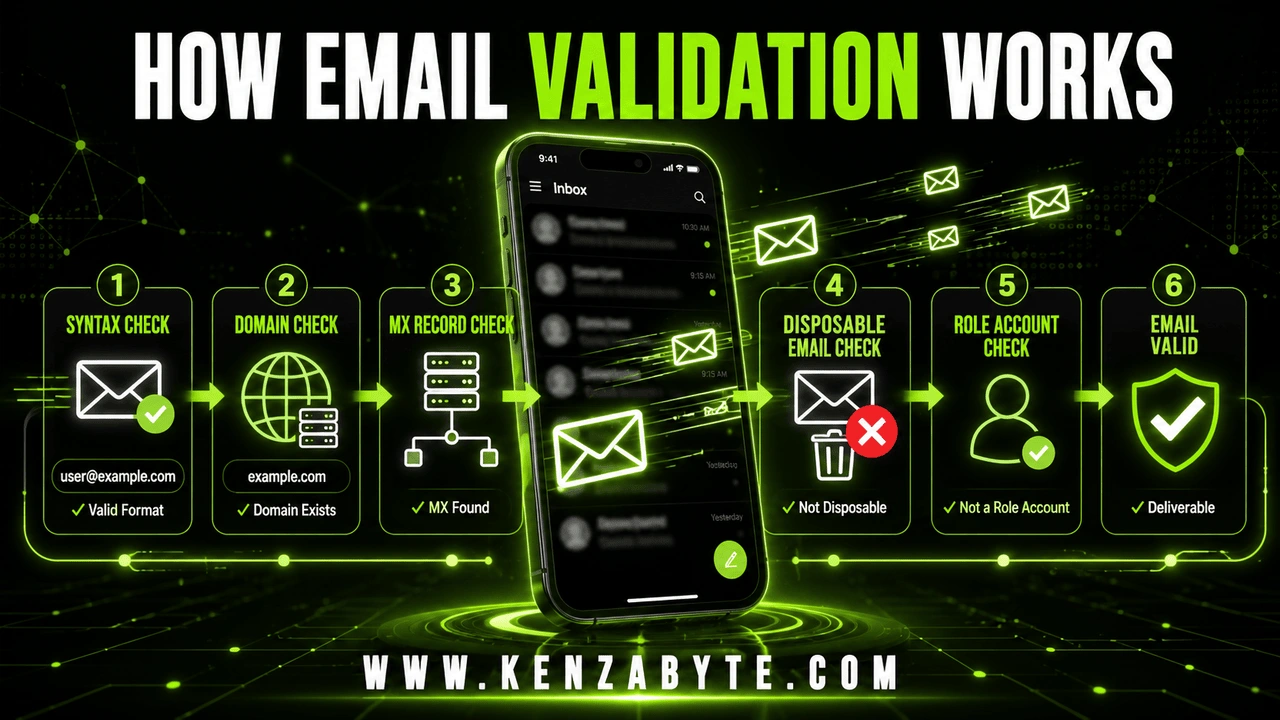
How Email Validation Works: Step by Step
Email validation uses several checks to confirm the address is valid. Here’s a simple explanation:
Step 1: Syntax Check
- Checks if the email format is correct.
- Example:
name@domain.comis correct;name@domainis incorrect.
Step 2: Domain Check
- Verifies the domain exists.
- Example:
example.commust exist on the internet.
Step 3: MX Record Check
- MX records tell email servers where to deliver emails.
- Validation ensures the domain has active email servers.
Step 4: Role Account Check
- Checks if the email is a generic account like
info@domain.comorsupport@domain.com. - These are usually not ideal for marketing emails.
Step 5: Disposable Email Check
- Detects temporary emails like
xyz@mailinator.com. - Such emails are often used once and can harm email campaigns.
Step 6: SMTP Check (Optional)
- Connects to the mail server without sending an email.
- Confirms the mailbox exists and can receive messages.
Types of Email Validation Tools
Email validation can be done manually or with tools. Here are the common types:
- Online Validators: Websites where you can paste emails to check validity.
- API-Based Validators: Tools integrated with software to validate emails in real-time.
- Bulk Validators: For large email lists, they check thousands of emails at once.
Common Email Validation Mistakes to Avoid
Email validation is an essential step in maintaining a healthy email list and ensuring your campaigns succeed. However, many businesses make mistakes that reduce the effectiveness of their validation process. Understanding these common mistakes can help you avoid wasted resources, poor deliverability, and low engagement.
1. Sending Emails Without Validation
One of the biggest mistakes is sending emails without first validating your list. Skipping validation means your emails may be sent to invalid or fake addresses. This leads to high bounce rates, which can damage your sender reputation and increase the chances of your emails landing in spam folders. Always validate your emails before starting any marketing campaign to ensure your messages reach real users.
2. Using Outdated Email Lists
Even previously validated email addresses can become inactive over time. Users may change their email, abandon old accounts, or close services. Sending to outdated lists can result in unnecessary bounces and low engagement. Regular email validation keeps your lists up-to-date, ensuring your campaigns reach active and interested recipients.
3. Ignoring Temporary or Disposable Emails
Some people use temporary or disposable emails to avoid spam or sign up for one-time offers. These addresses often expire quickly and cannot be used for long-term campaigns. Ignoring this during email validation can lead to wasted resources and inaccurate performance metrics. Identifying and removing disposable emails ensures your marketing reaches genuine contacts.
4. Not Verifying Role-Based Accounts
Role-based emails such as info@company.com, support@domain.com, or sales@domain.com are designed for general inquiries rather than personal communication. Sending marketing campaigns to these addresses usually results in lower engagement. Email validation can identify and flag these accounts so you can decide whether to include them in your campaigns.
Why Avoiding These Mistakes Matters
By avoiding these common mistakes, you maximize the benefits of email validation. Your email campaigns will have higher deliverability, better engagement, and lower costs. Clean, validated email lists protect your sender reputation, improve ROI, and ensure your marketing efforts are effective.
FAQs About Email Validation
Is email validation free?
Some email validation tools offer free checks for a limited number of emails, usually between 50 to 100. This is useful for testing or small lists. For large email lists, most reliable services require a paid plan because validating thousands of emails requires server resources and advanced verification techniques. Using free tools for large lists can lead to inaccurate results.
Can email validation prevent spam?
Email validation cannot prevent spam directly. Its main purpose is to reduce fake, invalid, or disposable emails in your list. By removing these, your campaigns are more likely to reach real recipients, reducing the risk of being flagged as spam. However, it does not replace spam filters or anti-spam laws.
How often should I validate my email list?
Email addresses can become inactive over time, so it’s recommended to validate your list every 3 to 6 months. Regular validation keeps your data clean, ensures high deliverability, and improves campaign engagement.
Does email validation send emails?
No, email validation does not send messages. Instead, it checks whether an email is properly formatted, if the domain exists, and whether the mailbox can receive emails. It’s a non-intrusive way to confirm deliverability without disturbing recipients.
Can I validate Gmail or Yahoo emails?
Yes, you can validate Gmail, Yahoo, and other major email providers. However, some servers may block deep verification due to privacy measures, meaning you may not always get 100% confirmation of existence. In such cases, syntax and domain checks are still reliable.
What is a disposable email?
A disposable email is a temporary address used for a short period, often to avoid spam or bypass sign-ups. These emails usually expire within hours or days and are not suitable for long-term campaigns. Email validation identifies and removes these addresses from your lists.
Is email validation legal?
Yes, email validation is legal as long as you comply with privacy regulations like GDPR in Europe or CAN-SPAM in the U.S. Validation is considered a data hygiene practice and does not violate privacy laws when used responsibly.
Conclusion
Email validation is a simple but powerful process that ensures your emails reach real people. By using email validation, you can improve marketing results, protect your reputation, and save costs. Always validate your email lists regularly to get the best performance.

Arabella Montrose
I have over 8 years of experience in content writing, specializing in Telegram automation, user-friendly tools, and social media marketing services. I work closely with the Kenza Byte team to ensure every article I write is accurate, clear, and genuinely helpful for users and businesses focused on digital growth.