Telegram Session Strings vs Telegram TData – Complete Guide
Telegram uses multiple formats to store and manage authentication and user state. These formats exist at different layers of the ecosystem, ranging from full desktop client storage to lightweight API-level tokens. Understanding how TData, session strings, and session identifiers function is essential for designing reliable systems around Telegram.
This guide breaks down each format, explains where it is used, and clarifies how they relate without overlapping concepts.
What Is Telegram Desktop Data (TData)?
TData is the internal storage format used by Telegram Desktop. It is a directory that contains encrypted binary files responsible for maintaining the application’s full state.
This includes authentication, cached messages, encryption keys, and configuration data.
TData is automatically created when logging into Telegram Desktop and persists across sessions so the user does not need to log in repeatedly.
Key characteristics:
- Stored as a folder, not a single file
- Contains encrypted authentication keys
- Includes cached chats, media, and metadata
- Bound to the local machine and environment
TData is not designed for external usage. It operates strictly within the Telegram Desktop application.
What Does TData Contain?
TData holds significantly more information than what is required for simple authentication.
It typically includes:
- Authorization keys (auth_key)
- Data center routing information
- Local encryption keys
- Cached user, chat, and message data
- Session configuration tied to the desktop client
Because of this, TData represents a complete client state rather than just a login token.
Why TData Cannot Be Used Directly Outside Telegram Desktop
TData is tightly bound to the Telegram Desktop environment.
Limitations include:
- Encrypted using device-specific parameters
- Uses a proprietary storage structure
- Contains more data than required for API-level access
- Not compatible with Python-based libraries without extraction
To use TData in automation systems, it must be converted into a session format that API clients understand. This process involves extracting only the required authentication components.
What Is a Telegram Session String?
A session string is a compact, encoded representation of a Telegram session. It contains only the essential data required to authenticate a user via the Telegram API.
Unlike TData, it does not include cached messages or extended client state.
Core components inside a session string:
- Authorization key
- Data center ID
- User identification data
The session string is encoded into a single line, making it easy to store and transfer.
Can Session Strings Be Generated Using Pyrogram or Telethon?
Session strings are not a native Telegram feature. They depend on how a client chooses to store session data.
Direct answer:
- Pyrogram can generate session strings
- Telethon does not natively generate session strings
Explanation:
Some clients provide a built-in way to export session data as a string. Others store sessions as local files without offering a direct string format.
Any session string outside native support is typically created by converting existing session data into an encoded form.
Conclusion:
- Session string support depends on the client
- Not all clients generate them directly
- Conversion may be required for reuse
Where Session Strings Are Used
Session strings are used in API-based environments where authentication needs to be handled without relying on local files.
Typical scenarios include:
-
Applications that interact with Telegram programmatically
-
Situations where session data is passed directly instead of being stored
-
Environments where portability of authentication data is required
They allow systems to authenticate without depending on file-based session storage.
Session portability at this level is part of a Telegram account creator structure where session formats, storage methods, and execution environments are structured together to maintain consistent access across different system layers.
How Session Strings Are Created
Session strings are produced by encoding an already established session.
The process follows a simple transformation:
- A session is first created through normal authentication
- The essential connection data is extracted
- This data is then encoded into a compact string format
No new authentication method is introduced. The string is only a different representation of an existing session.
For implementation-level differences between Telethon and Pyrogram sessions, refer to: The Difference Between Telethon and Pyrogram Session Files
What Is a Telegram Session ID?
The term “Session ID” is often misunderstood.
Telegram does not provide a standalone session ID that can be used independently for authentication.
Internally, sessions are defined by a combination of:
- Authorization key
- Server salt
- Connection metadata
What is commonly referred to as a “Session ID” is usually one of the following:
- A session string
- A reference inside a session file
- A user-defined identifier in a system
There is no separate, reusable ID that replaces the need for full session data.
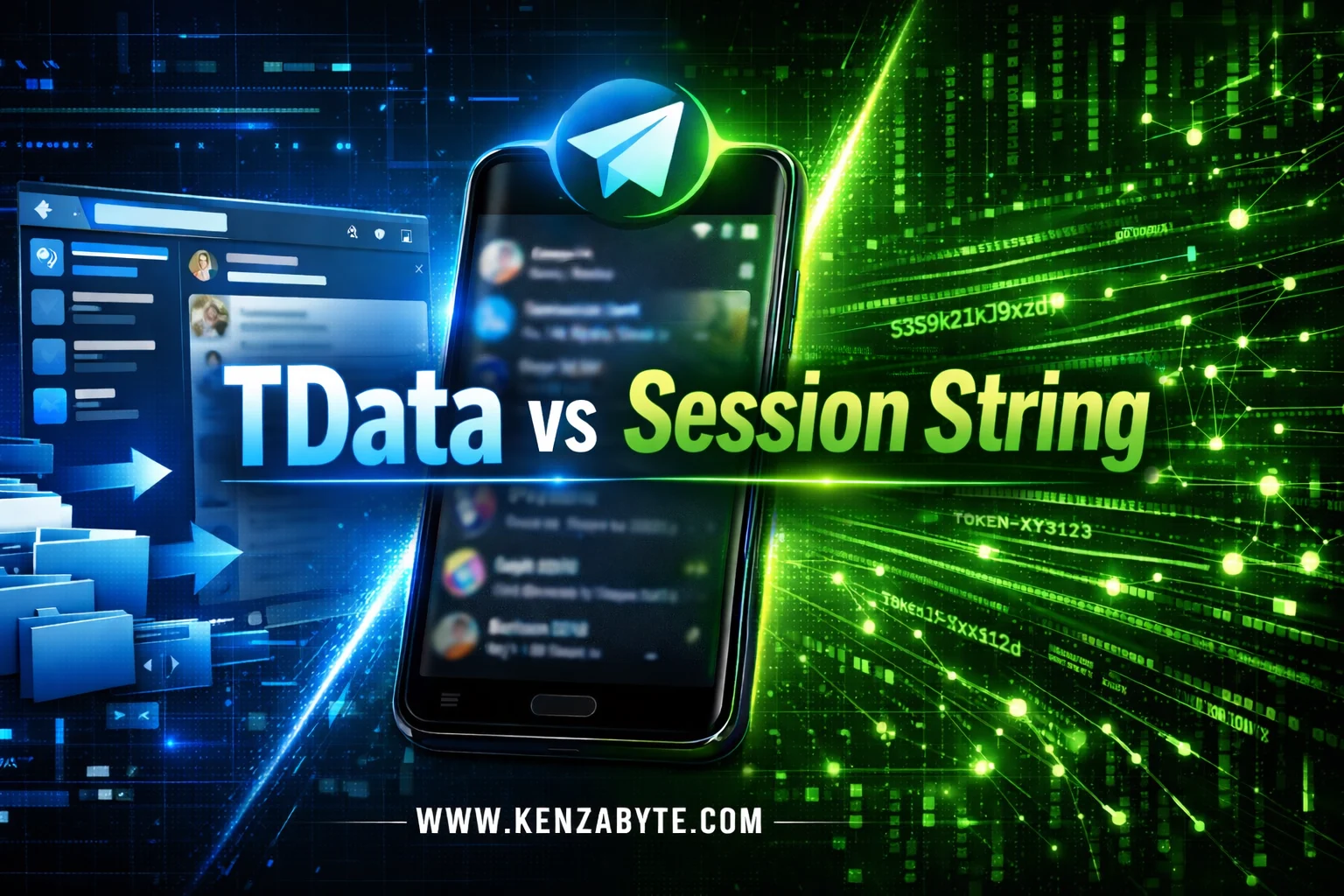
Telegram Data [ TDATA ] vs Session String
These two formats operate at completely different levels.
TData represents a full desktop client state, while a session string represents only the authentication layer.
Key differences:
- TData is a directory with encrypted files
- Session string is a single encoded value
- TData is not portable
- Session string is highly portable
- TData includes cached data and metadata
- Session string includes only connection essentials
They are not interchangeable formats.
Why TData and Session Strings Are Not Interchangeable
TData and session strings operate at different abstraction layers.
TData is designed to support a full desktop application, including caching, synchronization, and local state management.
Session strings represent only the minimal data required to establish a connection.
Because of this:
- TData includes significantly more information than required for authentication
- Session strings intentionally exclude all non-essential data
- Each format is optimized for a different runtime model
This difference is structural, not superficial. One cannot replace the other without transformation.
What Is Telegram Desktop Internally?
Telegram Desktop is a full-featured client built to provide a complete messaging experience.
It handles:
- Authentication
- Encryption
- Message synchronization
- Local caching
All session handling is abstracted away from the user and stored inside TData.
The application generates and manages authentication keys automatically and reuses them for future connections.
Security Differences
TData and session strings differ significantly in how they handle security.
TData:
- Encrypted with system-dependent keys
- Harder to extract or move
- Designed for local application security
Session string:
- Encoded but not device-bound
- Easily transferable
- Requires manual protection
If exposed, a session string can be reused immediately. TData, in contrast, is more resistant to direct reuse due to its structure.
Where TData Is Used
TData is used only in desktop environments.
Typical usage includes:
- Running Telegram Desktop
- Maintaining persistent login sessions
- Storing local chat history and media
It is not suitable for programmatic or distributed systems.
When TData Becomes Relevant
TData becomes relevant when working with existing desktop sessions.
Examples:
- Migrating an account from a desktop to an automated system
- Extracting authentication data from a logged-in machine
- Analyzing how Telegram Desktop stores session data
When Session Strings Become Necessary
Session strings become necessary when session data cannot depend on local file storage.
They are used when:
- Session data needs to be transferred between environments
- Authentication must be provided directly as input
- Local storage is not used or is not available
They remove dependency on local files, but do not change how authentication itself works.
Structural Insight
TData functions as a complete, device-bound state container.
Session strings function as portable authentication tokens.
They represent two layers of the same system:
- Application layer (TData)
- API layer (session string)
Each is optimized for a different operational model.
Final Summary
Telegram uses different formats to handle authentication depending on the environment.
- TData is used by the desktop client and stores the full application state
- Session strings are used in API-based systems and store only essential authentication data
- Session IDs are not standalone authentication tools but internal identifiers
These formats are not interchangeable. They are designed for different layers of usage, and their structure reflects their purpose.
Understanding this separation is necessary for building systems that interact with Telegram reliably without misinterpreting how session data works.

Arabella Montrose
I have over 8 years of experience in content writing, specializing in Telegram automation, user-friendly tools, and social media marketing services. I work closely with the Kenza Byte team to ensure every article I write is accurate, clear, and genuinely helpful for users and businesses focused on digital growth.