Telegram Session Files: Telethon vs Pyrogram Differences
In this article, we examine how Telegram session data is created, stored, and reused in automation environments. It compares how Telethon and Pyrogram manage authentication state, explains their incompatibility, and outlines where each approach fits in real system design.
What Does a Telegram Session Actually Represent?
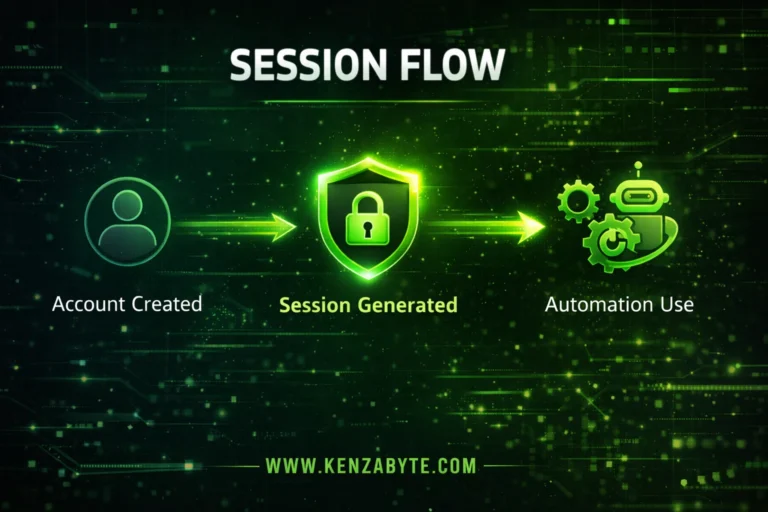
A Telegram session is a stored authentication state that allows a client to reconnect without repeating verification steps like OTP.
It usually includes:
- authorization key
- data center routing details
- device and application identity
- cached references to users, chats, or channels
This data allows scripts and services to resume operations without initiating a new login flow.
How Do Telethon and Pyrogram Sessions Differ Structurally?
Telethon Session
Stored as a .session SQLite database with a multi-table layout.
Contains:
- auth_key
- dc_id
- server configuration
- cached entities (users, groups, channels)
Behavior:
Built for persistent environments. It keeps historical interaction data and reduces repeated API lookups through caching.
Pyrogram Session
Supports two formats:
.sessionfile- session string (encoded form)
Structure is simplified and focused on connectivity.
Behavior: Designed for portability. Session strings allow usage across systems without transferring database files.
Why Can’t Telethon and Pyrogram Sessions Be Used Interchangeably?
The limitation comes from internal design differences.
- separate database schemas
- different encoding and decoding logic
- distinct abstractions over Telegram’s protocol layer
In practice:
- Telethon sessions operate only within Telethon-based implementations
- Pyrogram sessions operate only within Pyrogram-based implementations
Even when both rely on SQLite, their internal layouts are incompatible, causing parsing or authentication failure.
What Happens When You Try Converting Sessions?
Conversion tools attempt to extract and remap:
- auth_key
- dc_id
- user_id
However, real-world behavior shows:
- Cached entities are not preserved
- Some sessions fail during reuse
- mismatched versions break compatibility
This reflects a bigger architectural difference rather than a simple format mismatch.
What Is “Session + JSON” and Why Is It Used?
In many Telethon-driven systems, the session file is paired with a JSON file.
The JSON layer is external and used for system-level control, not for Telegram authentication.
Example JSON
{
"session_file": "+8801993971524",
"phone": "+8801993971524",
"app_id": 27853475,
"app_hash": "e491a6daee63c1ac536d97e4f4e25044",
"sdk": "Desktop",
"app_version": "4.16.8 x64",
"system_version": "Windows 10",
"avatar": "null",
"first_name": "Hd",
"last_name": "Df",
"username": null,
"lang_code": "en",
"system_lang_code": "en-US",
"proxy": null,
"ipv6": false,
"password_2fa": null
}
What This JSON Actually Does
It separates operational layers:
- session → authentication and connection state
- JSON → identity, configuration, and runtime parameters
Used for:
- managing multiple accounts
- storing API credentials
- defining device fingerprints
- handling proxy, language, and security settings
Telethon workflows commonly adopt this separation due to structured automation requirements.
Pyrogram implementations generally avoid this pattern since session strings already carry required connection data.
Which Session Works with Which Module or System?
This mapping follows actual implementation behavior.
Telethon Sessions → Telethon-Based Systems
Applied in environments where:
- Entity reuse is required
- processes run continuously
- Multiple accounts are coordinated
Common modules:
- data extraction pipelines
- messaging systems
- account orchestration frameworks
Pattern: Session handles authentication, JSON handles control logic.
Pyrogram Sessions → Pyrogram-Based Systems
Applied in environments where:
- components are modular
- Deployment is distributed
- Portability is required
Common modules:
- bot architectures
- API services
- microservice-based tools
Pattern: Session string is directly injected and used without additional metadata layers.
Practical Use Case Difference Based on System Behavior
Telethon aligns with state-driven systems.
Typical execution:
- load stored session
- reuse cached entities
- reduce redundant API calls
- maintain continuous workflows
Pyrogram aligns with execution-driven systems.
Typical execution:
- provide session string
- run isolated operation
- terminate or scale horizontally
This difference determines how each library integrates into the system architecture.
These execution patterns align within a structured Telegram account creation workflow where session format, execution model, and system structure are coordinated to maintain stable and scalable account operations.
What Types of Telegram Sessions Exist?
1. Session File
- SQLite-based storage
- resides locally
- used by both libraries with different schemas
2. Session String (Pyrogram)
- encoded authentication state
- easily transferable
- suitable for cloud or CI/CD usage
3. TData (Desktop)
Used by Telegram Desktop
- binary storage format
- requires conversion before use in Python-based libraries
For a detailed comparison between TData & session strings: Telegram Session Strings vs Telegram TData.
What Causes Session Failures or Invalidations?
Environment Binding
Sessions depend on:
- API ID and hash
- device characteristics
- network/IP patterns
Changes in these parameters can invalidate the session.
Library Dependency
- Telethon session → usable only in Telethon
- Pyrogram session → usable only in Pyrogram
No shared compatibility layer exists between them.
Security Enforcement
Telegram may enforce:
- session revocation
- login rate limits
- forced re-verification
Conversion Instability
Failures arise from:
- incomplete data mapping
- schema differences
- incompatible encryption handling
When Should You Use Telethon vs Pyrogram?
Use Telethon when:
- persistent state is required
- Entity-level data reuse is needed
- Multiple accounts are centrally managed
Use Pyrogram when:
- Deployment flexibility is critical
- Architecture is modular
- sessions need to be portable
Use JSON when:
- handling multiple identities
- separating configuration from authentication
- orchestrating controlled workflows
Structural Insight
Telethon sessions function as stateful containers with extended context.
Pyrogram sessions function as portable tokens optimized for movement and reuse.
This distinction defines their operational boundaries.
Conclusion: Which Session Type Fits Which System?
Both libraries provide persistent authentication, but their priorities differ.
Telethon emphasizes continuity. It retains more context, supports entity caching, and fits systems that operate over extended periods with structured control. This leads to the frequent pairing of .session files with JSON metadata.
Pyrogram emphasizes mobility. It simplifies session handling and introduces session strings, making it suitable for distributed environments and modular execution models.
Key outcomes:
- Telethon session → aligned with state-driven, long-running systems
- Pyrogram session → aligned with portable, execution-focused systems
- JSON → external coordination layer, mainly used with Telethon
- Conversion → unreliable due to architectural differences
Final distinction:
- Telethon fits systems built around state, continuity, and control
- Pyrogram fits systems built around portability, simplicity, and deployment speed

Arabella Montrose
I have over 8 years of experience in content writing, specializing in Telegram automation, user-friendly tools, and social media marketing services. I work closely with the Kenza Byte team to ensure every article I write is accurate, clear, and genuinely helpful for users and businesses focused on digital growth.